
In the following video, Cyrill Moser, Head Provider Management, takes us through the Topic Deep Dive from 5 February 2026 and explains the key differences between active and passive investment strategies.

Passive investment strategies: efficient, cost-effective and transparent
Passive investment strategies aim to track the performance of a defined market as closely as possible. As a rule, this is done via index-related products such as ETFs, which weigh the securities contained in the index according to market capitalization. The focus is not on active stock selection, but on the smallest possible deviation, also known as tracking error, from the market return.
The key advantages of passive strategies include low costs, high transparency and simple and consistent implementation. Investors receive broad market diversification and benefit from the long-term development of efficient markets.
On the other hand, there are clear limitations. Passive strategies are exposed to the entire market risk and offer no opportunity to actively counteract it during downturns. Concentration risks also arise, as heavily weighted securities automatically take up a large proportion of the portfolio, regardless of their valuation.
Active investment strategies: selection, timing and risk management
Active investment strategies aim to achieve an excess return compared to the benchmark index through targeted overweighting and underweighting of individual securities. Portfolio managers base their decisions on fundamental analyses, quantitative models and macroeconomic assessments. The portfolio deliberately differs from the index with the aim of generating an excess return (alpha).
Active strategies offer particular advantages in less efficient markets. They enable active risk management, targeted positioning according to investment objectives and the exploitation of market inefficiencies. At the same time, they are associated with higher costs and require careful manager selection. Long-term studies show that the majority of active managers do not outperform their benchmark.
Growth of passive and active investments
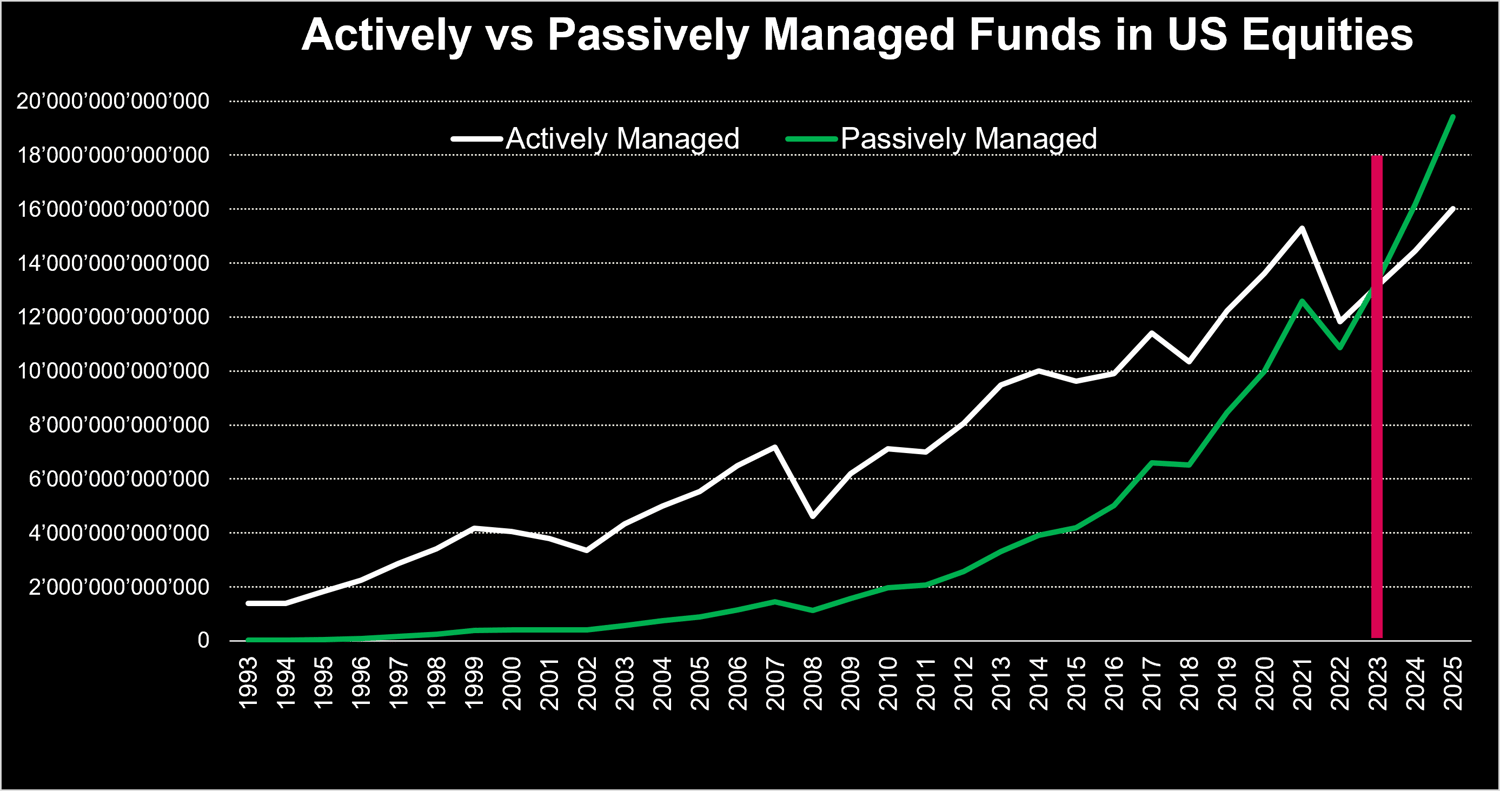
Growth of passive vs active US equity funds; Source: Morningstar 2025
The trend over the last few decades shows a clear shift in favor of passive strategies. In the USA, passively managed assets now significantly exceed those of active funds. The gap amounts to several trillion US dollars. The passive segment is also growing faster in Europe, although active strategies are still more prevalent there.
This development underlines the structural trend towards cost-efficient, transparent forms of investment, particularly in highly efficient markets.
Why active does not equal active
Despite the low average success rate of active managers, it is worth taking a differentiated view. Active strategies demonstrably achieve better results in certain market segments. These include small and mid caps, emerging markets, niche markets, bond markets and specialized investment themes. Active strategies can also often hold their own when implementing investment strategies such as "quality", "growth" or "value".
Success rate of active managers by market segment
The data shows that the probability of success of active managers depends heavily on market efficiency. In inefficient markets, the proportion of managers who beat their benchmark in the long term is significantly higher than in global markets with large-cap stocks. Activity develops its added value where information advantages, specialization and flexibility play a role.
Active ETFs as a bridge between two worlds
Active ETFs are becoming increasingly important. They combine active management approaches with the structural advantages of ETFs such as stock exchange trading, daily transparency and low minimum investments. Active ETFs are particularly suitable for accessing markets that are difficult to track or specific investment targets, but come with higher fees than traditional index products.
Key findings from the Topic Deep Dive
Six key statements can be derived from the analyses:
-
Active and passive strategies can both achieve good results and can be sensibly combined.
-
The average active manager does not achieve sustainable added value in the long term.
-
Selecting a very good active manager can pay off over longer periods of time.
-
Passive strategies are particularly suitable for efficient markets.
-
Active strategies are advantageous in less efficient markets, specialized strategies, bonds and tailor-made portfolios.
-
Regular review and monitoring of managers is crucial.
Conclusion
The question of "active or passive" cannot be answered in general terms. A structured combination of both approaches, tailored to the market segment, investment objective and risk profile, leads to better results in the long term. The decisive factors are transparency, cost awareness and consistent quality control of the providers used.